From Freshly Made Dough to Consistent, Scalable Production
In China’s highly competitive fast-food market, consumers are increasingly looking for products that combine the convenience of fast food with the taste and experience of freshly made food.
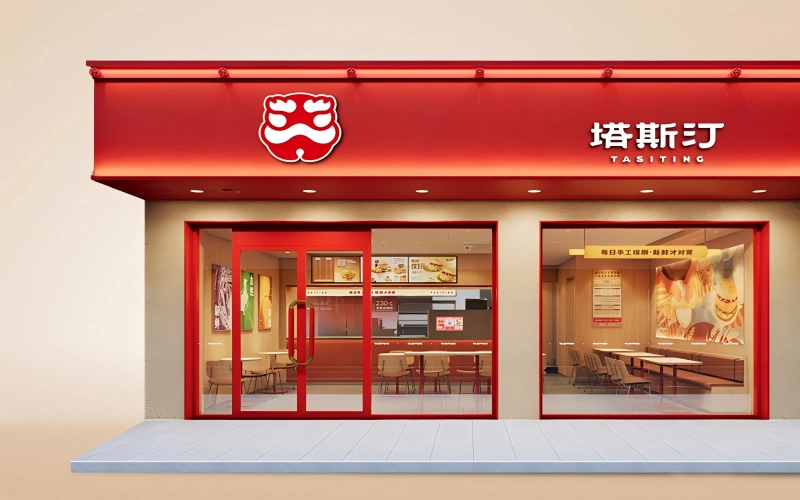
Tastien, one of China’s rapidly expanding burger brands, has built its distinctive market position around exactly this concept.
Unlike many traditional international fast-food chains, such as KFC and McDonald’s, Tastien’s burgers feature freshly prepared, hand-rolled and freshly baked burger buns. This process gives the buns a distinctive texture, aroma, and freshly baked flavor, creating a product experience that is different from conventional burgers made with pre-produced buns.
However, turning a handmade, freshly baked product into a standardized process across thousands of restaurants is a major operational challenge.
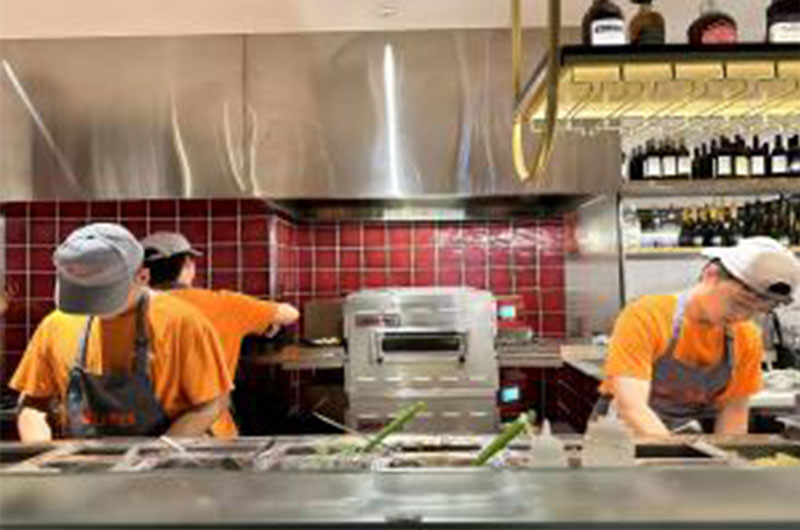
This is where our commercial conveyor pizza oven became an important part of Tastien’s production system.
Our cooperation was not simply about supplying an oven. We worked closely with Tastien’s kitchen application team and chefs to optimize the complete baking process — from menu application and oven parameter adjustment to baking-status evaluation and standardized SOP development.
The goal was simple:
To make freshly baked quality repeatable, consistent, and scalable.
The Challenge: Maintaining Fresh-Baked Quality at Scale
Tastien’s product concept is built around freshly prepared burger buns.
The buns are made from dough and shaped by hand before being baked fresh in the restaurant. Compared with conventional burger production based on standardized pre-made buns, this process creates a more distinctive eating experience.
The challenge, however, is that freshly made dough is much more sensitive to production conditions.
Factors such as:
Dough formulation
Dough weight and thickness
Proofing conditions
Baking temperature
Conveyor speed
Baking time
Heat distribution
Product placement
Production environment
can all influence the final result.
A slight change in baking conditions can affect the bun’s color, crust, internal texture, moisture, and overall eating experience.
For a single restaurant, these variables can often be managed by an experienced kitchen team.
But when a restaurant concept expands to thousands of locations, maintaining consistency becomes much more difficult.
Tastien needed a baking solution that could not only deliver the required baking performance, but also support a repeatable and easy-to-operate production process.
Our Solution: More Than Just an Oven
To support Tastien’s application, we provided more than a piece of commercial baking equipment.
We worked closely with their kitchen application team and chefs to develop a practical baking solution tailored specifically to their freshly made burger buns.
Our approach focused on three key areas:
1. Kitchen Application & Menu Development
At the early stage of the cooperation, our kitchen application chefs worked together with Tastien’s team to understand the product characteristics and production requirements.
Rather than starting with fixed oven settings, we evaluated the actual product and its baking behavior.
We tested different baking conditions and adjusted the oven parameters according to the characteristics of the dough and the desired finished product.
The focus was not simply on achieving a visually acceptable bun.
We looked at the complete result:
Appearance + Color + Texture + Moisture + Baking Consistency + Production Efficiency
Through repeated testing and adjustment, the oven was adapted to the specific requirements of Tastien’s freshly baked burger buns.
2. Oven Parameter Optimization
One of the most important parts of the project was establishing suitable oven parameters for the freshly made dough.
A commercial conveyor oven provides multiple variables that can be adjusted to control the baking process, including temperature and conveyor speed.
Our application team worked with Tastien to determine suitable parameter combinations for their products.
Instead of relying entirely on individual operator experience, the baking process was gradually transformed into a more standardized system.
The objective was to identify parameters that could consistently produce the desired result under normal restaurant operating conditions.
This was particularly important because Tastien’s business model required the same product concept to be reproduced across a rapidly growing restaurant network.
The final process needed to be:
Easy to understand. Easy to operate. Easy to replicate.
3. Teaching Operators How to Read the Baking Process
For freshly baked products, simply setting the oven temperature is not enough.
Operators also need to understand what is happening during the baking process.
Our kitchen application team therefore helped Tastien’s staff learn how to evaluate the baking condition of the burger buns by observing key visual and physical indicators.
These included the product’s:
Surface color
Browning level
Shape
Crust condition
Internal texture
Overall baking degree
This knowledge allowed restaurant teams to identify whether a product was under-baked, properly baked, or over-baked, and understand how oven settings could influence the final result.
This type of practical training was especially valuable for a product made from freshly prepared dough, where the raw material can naturally have some variation.
Instead of simply providing the customer with an oven manual, we helped turn baking knowledge into an operational methodology.
From Expert Experience to a Standardized SOP
One of the key outcomes of our cooperation with Tastien was the development of a mature Standard Operating Procedure (SOP) for the baking process.
This was an important step in transforming professional kitchen experience into a repeatable restaurant operation.
The SOP helped define the key steps of the baking process, including:
Preparation → Dough Handling → Proofing → Oven Setup → Baking → Quality Inspection → Production Standard
By establishing standardized operating parameters and quality standards, the baking process became less dependent on individual experience.
This is particularly important for large restaurant chains.
When a brand operates one or several restaurants, experienced employees can often compensate for process variations.
When a brand operates thousands of locations, however, relying on individual experience is no longer enough.
A successful chain requires a system that allows different teams, in different locations, to achieve a consistent product result.
Our role was to help Tastien build that system around its freshly baked burger concept.
Why the Conveyor Oven Was Important to Tastien’s Concept
The value of the commercial conveyor pizza oven in this project was not simply its heating capability.
For Tastien, the oven became part of a larger standardized food-production system.
The conveyor design provides a controlled and repeatable baking process, allowing operators to work with defined baking parameters rather than relying entirely on manual timing and individual judgment.
For a fast-growing restaurant brand, this provides several practical advantages.
Consistent Baking
Once the appropriate temperature and conveyor speed are established, operators can reproduce the baking process more consistently from batch to batch.
Easier Operation
The standardized process reduces the level of baking expertise required from individual restaurant employees.
Improved Production Efficiency
A conveyor-based process allows products to move continuously through the baking chamber, making it suitable for busy commercial foodservice environments.
Easier Training
Once the baking parameters and quality standards have been established, new employees can be trained according to a defined process.
Scalable Standardization
Most importantly, the same process can be documented and replicated across multiple restaurant locations.
For a rapidly expanding chain, this scalability is critical.
Supporting a Different Kind of Burger Experience
Tastien’s success is closely connected to its product differentiation.
While many conventional fast-food burgers use industrially produced, standardized buns, Tastien emphasizes freshly prepared, hand-rolled, and freshly baked burger buns.
This gives its burgers a different product identity.
The freshly baked bun becomes more than just a carrier for the filling. It becomes an important part of the overall eating experience.
The aroma of freshly baked dough, the texture of the bun, and the visual appeal of a freshly baked product all contribute to the perception of freshness.
This distinctive approach has helped Tastien rapidly expand its presence in China’s highly competitive burger market.
However, a differentiated product concept only works at scale when the production process behind it can also be standardized.
That is where our cooperation played an important role.
From One Kitchen to Approximately 12,500 Stores
The most significant challenge in this project was not developing a successful baking process in one kitchen.
It was making that process replicable at scale.
Tastien has experienced rapid expansion in the Chinese market, with its restaurant network growing to more than 10,000 locations, reaching approximately 12,500 stores.
For a restaurant network of this size, every operational detail matters.
A small difference in baking temperature, conveyor speed, or product handling can become a significant quality issue when multiplied across thousands of restaurants.
Therefore, the cooperation between our equipment team and Tastien’s culinary team focused on creating a system that could be transferred from the test kitchen to actual restaurant operations.
The process was essentially:
Product Development
↓
Kitchen Testing
↓
Oven Parameter Optimization
↓
Baking Evaluation
↓
Operator Training
↓
SOP Development
↓
Restaurant Implementation
↓
Scalable Chain Operation
This process transformed the oven from a standalone piece of equipment into part of Tastien’s standardized production solution.
Our Role: From Equipment Supplier to Application Partner
One of the most important lessons from the Tastien project is that successful commercial baking is not determined by equipment alone.
The right oven is only the starting point.
Different products require different baking conditions. Different dough formulations behave differently. Different production environments also create different operational requirements.
That is why our approach combines:
Commercial Baking Equipment + Culinary Application Support + Parameter Optimization + Operator Training + SOP Development
Our kitchen application chefs worked directly with the customer to understand the product and solve practical production challenges.
We helped the team answer questions such as:
What baking parameters are suitable for the product?
How should the oven be adjusted for the dough characteristics?
How can operators identify the correct baking condition?
What should the finished product look and feel like?
How can the process be standardized?
How can the same process be replicated across different restaurants?
These questions are just as important as the technical specifications of the oven itself.
A Scalable Baking Solution for Modern Foodservice
Tastien’s case demonstrates how commercial conveyor oven technology can support the expansion of freshly baked food concepts.
The challenge was to preserve the characteristics of a freshly made product while creating a process that could operate efficiently in a large-scale restaurant environment.
Through close cooperation between our equipment engineers, kitchen application chefs, and the Tastien team, the baking process was optimized from product testing to standardized restaurant operation.
The result was a practical system that connected:
Fresh Dough → Controlled Baking → Consistent Quality → Standardized SOP → Scalable Restaurant Production
This approach helped Tastien maintain the core characteristics of its freshly baked burger concept while supporting rapid expansion across the Chinese market.
The Bigger Picture
For us, the Tastien project represents more than a successful equipment application.
It demonstrates our belief that commercial food equipment should solve real production challenges, not simply provide technical specifications.
When a food brand is growing rapidly, equipment needs to support more than production capacity.
It needs to support:
Product consistency
Operational simplicity
Staff training
Quality control
Process standardization
Production efficiency
Multi-location scalability
Our commercial conveyor pizza oven was integrated into Tastien’s freshly baked burger production process with these objectives in mind.
By combining equipment technology with hands-on culinary application support, we helped turn a distinctive freshly baked product into a standardized production process that could be replicated across a rapidly growing restaurant network.
From Freshly Made Dough to Thousands of Stores
Tastien’s story shows that product differentiation and standardized production do not have to be opposites.
A restaurant brand can maintain the character of freshly made food while building a highly repeatable production system — provided that the right equipment, process parameters, training, and SOPs are developed together.
Our role is to help make that possible.
From the first baking test to the final SOP, we work with foodservice brands to develop commercial baking solutions designed not only for today’s kitchen, but also for tomorrow’s growth.