Nullam dignissim, ante scelerisque the is euismod fermentum odio sem semper the is erat, a feugiat leo urna eget eros. Duis Aenean a imperdiet risus.
Nullam dignissim, ante scelerisque the is euismod fermentum odio sem semper the is erat, a feugiat leo urna eget eros. Duis Aenean a imperdiet risus.
 author
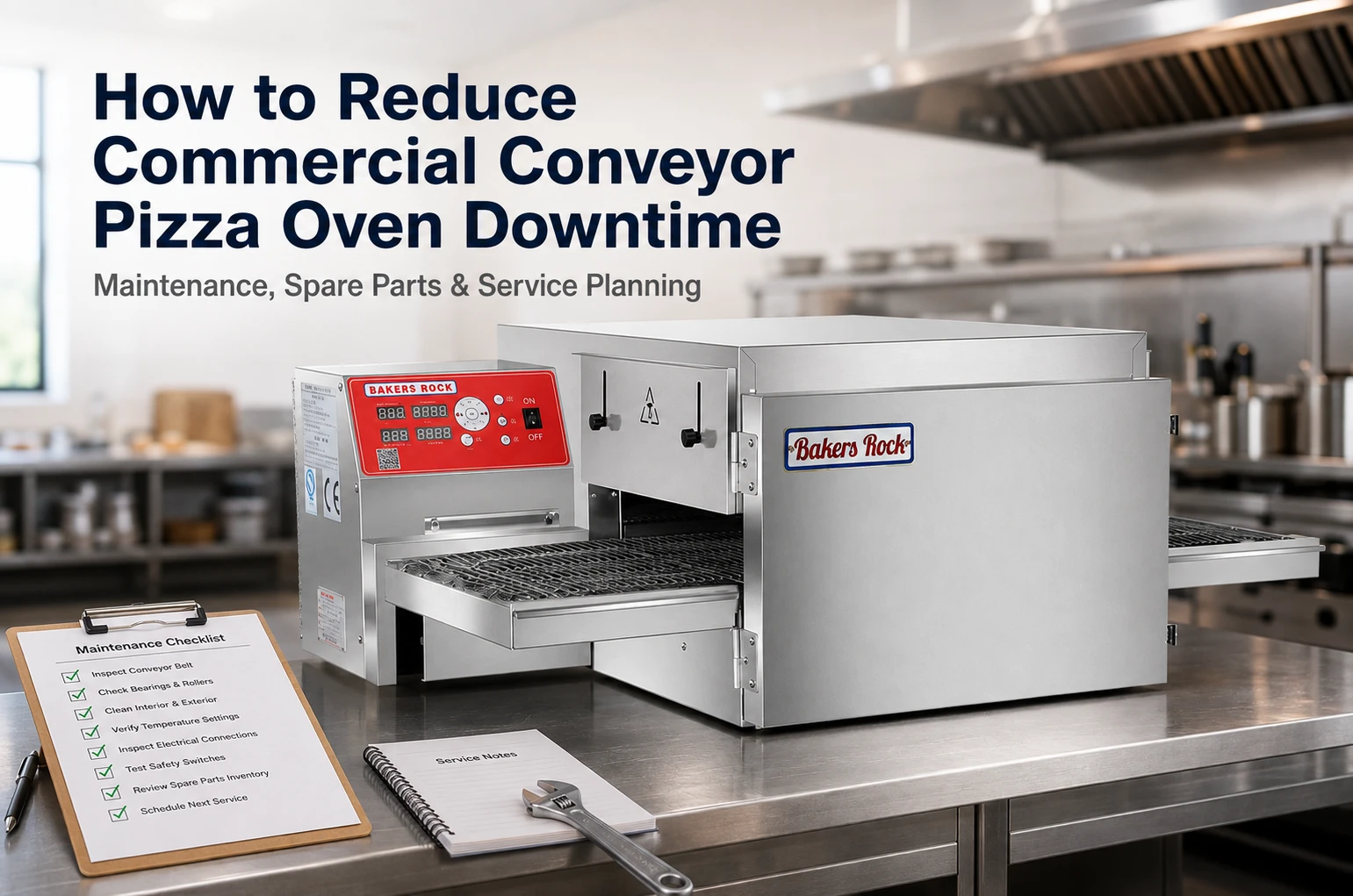
Commercial conveyor pizza oven downtime rarely begins at the exact moment the oven stops. Belt hesitation, repeated temperature variation, abnormal noise, recurring control errors, or longer recovery during heavy production can appear earlier. For a restaurant, pizza chain, or institutional kitchen, the practical objective is therefore not simply to repair equipment faster. It is to identify risk early, plan maintenance around operating conditions, prepare critical spare parts, document failures, and know when continued repair no longer makes business sense.
A useful conveyor pizza oven maintenance program treats uptime as an operating process. Daily checks, technical service, parts planning, shutdown response, restart validation, and future equipment selection should support the same goal: reducing unplanned interruption during revenue-critical service periods.
Reducing commercial conveyor pizza oven downtime requires five connected actions:
For multi-unit restaurants, the plan should also address business continuity. A maintenance program is incomplete if one equipment failure can stop the entire pizza line with no temporary production strategy. Bakers Rock’s own guidance on stacked and single large conveyor configurations notes that maintenance access, replacement parts, and unexpected downtime should be considered when planning capacity.
Many shutdowns are preceded by observable changes. The purpose of early inspection is not to diagnose every internal fault but to recognize when normal operation has changed enough to justify investigation.
| Warning sign | Risk area to investigate | Recommended next step |
|---|---|---|
| Belt hesitates or travel time changes | Conveyor drive or control | Record actual travel time and arrange inspection |
| Repeated temperature variation | Heating, sensor, or control system | Compare settings with repeatable product results |
| Fixed hot or cold area | Heat delivery or airflow | Investigate before compensating with new settings |
| New vibration or abnormal noise | Mechanical system | Schedule inspection before peak service |
| Repeated trips or control errors | Electrical/control system | Record evidence and escalate appropriately |
Bakers Rock’s troubleshooting guidance already treats conveyor movement, airflow, heating response, and controls as separate systems that should be tested methodically. It also recommends measuring actual conveyor travel time rather than assuming the displayed setting reflects real movement.
The goal is early escalation. If an operator repeatedly corrects symptoms by increasing temperature, slowing the belt, or restarting the oven, the underlying condition may remain until it causes a more serious interruption.
A commercial pizza oven preventive maintenance schedule should reflect the specific model, manufacturer instructions, operating hours, production load, cleaning conditions, and failure history. A busy delivery store operating for long periods each day does not necessarily have the same maintenance priorities as a low-volume café using similar equipment.
Operators are well positioned to notice visible and repeatable changes: unusual belt movement, new noises, excessive residue, control messages, damaged accessible components, or changes in cooking consistency. These observations can be recorded without opening internal electrical or drive systems.
Technician-level work should begin where the equipment manual, electrical system, drive mechanism, heating components, or other internal systems require trained service. The boundary matters because unnecessary disassembly or repeated resets can complicate diagnosis and create additional risk.
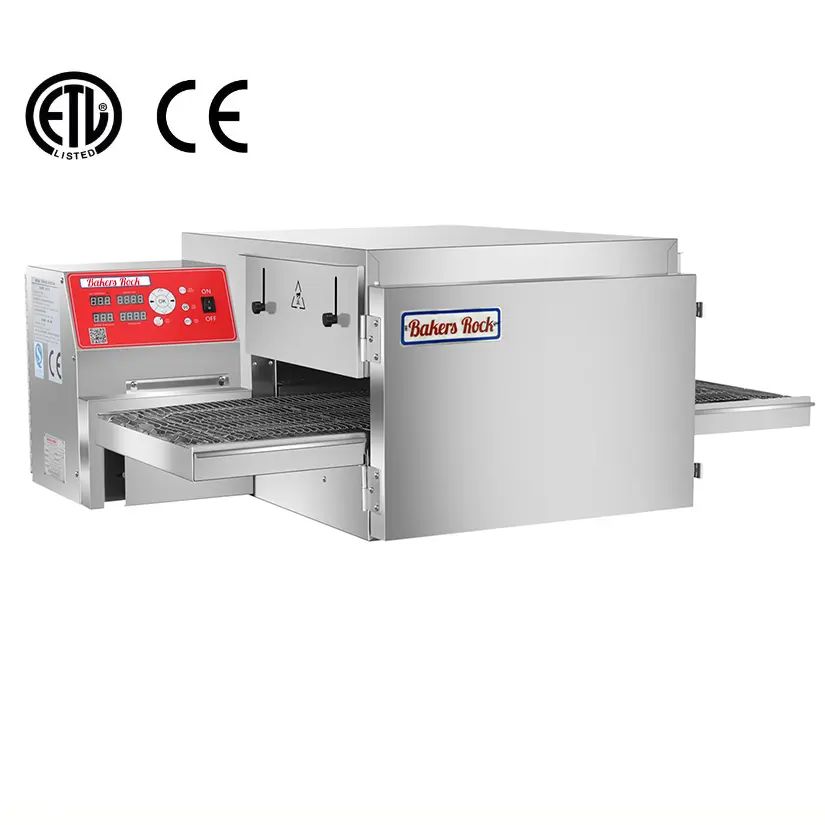
Cleaning is also part of uptime planning. Bakers Rock notes that some conveyor models use removable or accessible components intended to make routine cleaning and maintenance easier. Its H1624Pro, for example, has a fully opening front door and a quick-release front panel intended to improve cleaning and service access.
Avoid a universal statement such as “service every three months” unless the exact model documentation specifies it.
Instead, keep a maintenance record containing operating hours when available, cleaning dates, recurring symptoms, technician visits, parts replaced, belt observations, control errors, and production conditions when the problem occurred.
A repeated issue deserves a higher inspection priority than a component with no abnormal history. Likewise, an oven operating continuously through long peak periods may require a different service plan from equipment used intermittently.
The useful question is not only, “When was this oven last serviced?” It is, “What conditions has this oven been operating under since the last inspection?”
Waiting for a part can turn a small equipment fault into a long production interruption. At the same time, stocking every possible component is rarely practical.
A B2B spare-parts plan should consider four factors: the operational impact if the part fails, replenishment time, the number of identical ovens installed, and access to qualified local service.
A simple rule is:
High downtime impact + long replenishment time = investigate whether the part should be stocked in advance.
Parts with low production impact and short replacement lead times can usually be handled differently.
Do not build a spare-parts inventory from generic component names alone. Request exact model-specific part numbers and revision information. Bakers Rock’s supplier-audit guidance specifically recommends separating routine wear items from downtime-critical components and verifying part identification, revisions, lead times, documentation, and installation requirements before equipment is placed into service.
For chains using multiple identical ovens, standardizing equipment can also simplify stocking decisions because one verified spare may support more than one location, subject to exact model compatibility.
When an oven stops during a rush, pressure to restart it immediately is understandable. However, useful failure information can disappear if staff repeatedly reset controls or change multiple settings before documenting what happened.
Create a simple downtime incident record. Before changing anything that is not required for safe shutdown, record:
This information can make communication with technical support far more precise. Bakers Rock’s supplier and service guidance emphasizes matching technical evidence, configuration, parts, and testing to the exact oven rather than relying on information from a similar model.
Operators should stop troubleshooting when symptoms move beyond routine checks or the actions permitted by the equipment documentation. Repeated electrical trips, unstable drive behavior, persistent control faults, unusual heating response, or conditions involving internal electrical or gas systems should be escalated to qualified service personnel.
The objective is not to turn restaurant staff into oven technicians. It is to give them a clear escalation point.
Bakers Rock provides a dedicated after-sales channel for maintenance, replacement-parts inquiries, and operating support, which illustrates why service access should be planned before a breakdown rather than searched for after production has stopped.
An oven powering on again does not necessarily mean the original problem has been resolved.
After service, follow a controlled restart sequence appropriate to the model and service performed. Observe the oven without production first where applicable, verify conveyor movement and actual travel time, then bake a standardized product.
If consistency was part of the original problem, compare identical products across the usable cooking area. Finally, repeat loading to determine whether performance remains stable as production continues. Bakers Rock’s existing troubleshooting methodology uses standardized pizzas, multiple positions, and actual conveyor-time checks to separate equipment problems from product variation.
Return the oven to a major dinner rush only after the repair has been validated under conditions that reasonably represent normal commercial operation.
Maintenance cannot eliminate every failure. Restaurant operations should therefore ask what happens if the primary oven becomes unavailable.
A temporary plan may include menu prioritization, an alternative production line, available secondary equipment, or an approved stacked or multi-oven configuration. Bakers Rock’s comparison of single large and stacked conveyor ovens notes that component independence, maintenance planning, spare-parts availability, and temporary production planning all affect downtime exposure.
Repeated downtime also raises a different question: repair or replace?
Review the pattern rather than one isolated repair bill. Frequent failures across several systems, increasingly difficult parts availability, long recovery periods, insufficient peak-hour capacity, or reliability that remains poor after reasonable repairs can justify a replacement review. Bakers Rock’s new-versus-used guidance similarly identifies parts availability, service history, testing, and unplanned downtime as factors that affect the real equipment decision.
Downtime prevention should start during procurement.
Buyers often compare belt width, temperature, power, capacity, and purchase price while giving less attention to serviceability. A more complete evaluation should examine cleaning access, service-panel access, availability of manuals and parts information, replacement-parts identification, warranty scope, technical-support channels, and whether common models can be standardized across multiple stores.
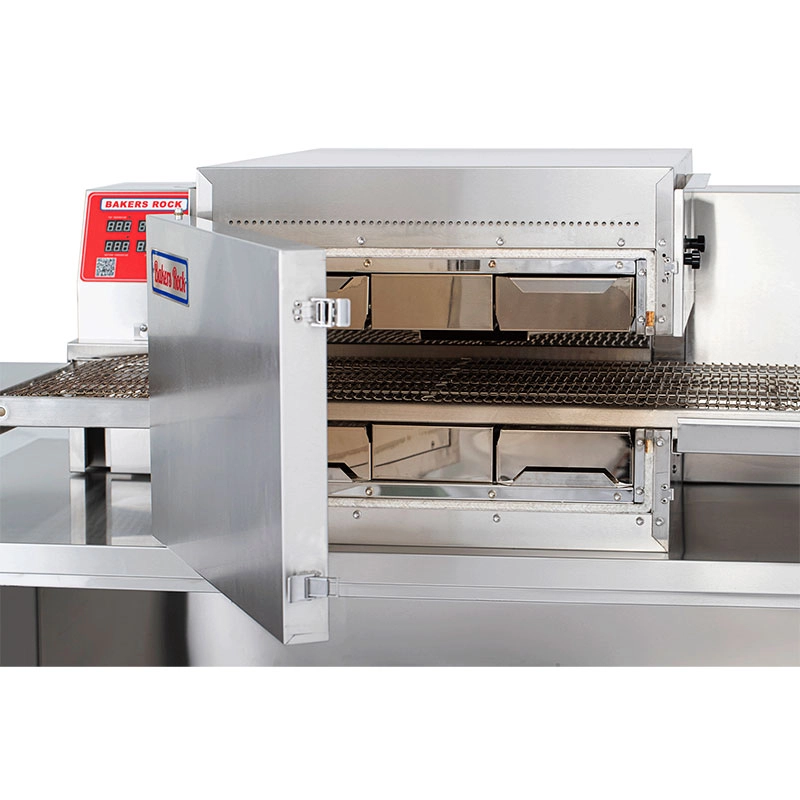
The H1624Pro 16-inch countertop conveyor oven provides a concrete example of a maintainability feature: its published design includes a front door that opens fully and a quick-release front panel for easier cleaning and service access. The product page also identifies the model for small pizzerias, food trucks, cafés, buffets, and snack bars.
For buyers comparing broader configurations, Bakers Rock commercial conveyor pizza ovens include multiple conveyor categories and capacities, while the company’s current site also provides separate product, technical, and after-sales paths.
Supplier capability matters as much as the hardware. The Bakers Rock manufacturer profile identifies Shanghai QiangAn FoodService Equipment Co., Ltd. as the manufacturer behind the brand and describes its focus on conveyor pizza oven solutions for pizza chains, pizzerias, restaurant groups, and institutional foodservice.
The procurement question should therefore be: “If this oven becomes production-critical, can the exact configuration be identified, serviced, documented, and supported?”
A detailed service or replacement request can reduce unnecessary back-and-forth.
Provide the current oven model and nameplate photograph, failure symptoms, maintenance history, photos or video, operating hours if known, pizza diameter, typical bake time, peak production requirement, available utilities, installation space, and required service or spare-parts support.
If replacement is being considered, include the specific reason: repeated breakdowns, insufficient capacity, unavailable parts, difficult cleaning or service access, or a change in menu and production demand.
Bakers Rock’s replacement guidance similarly recommends documenting the existing model, product requirements, utilities, space, capacity, and support needs before selecting a new configuration.
Reducing commercial conveyor pizza oven downtime requires a connected process: detect changes early, maintain according to actual operating risk, prepare critical spares, document failures, escalate safely, validate repairs, and learn from repeated incidents.
When downtime becomes frequent enough to trigger a replacement review, serviceability and support should be evaluated alongside capacity and baking performance.
For a maintenance-related replacement or new equipment project, buyers can contact Bakers Rock with the oven model, failure symptoms, photos or video, maintenance history, pizza specifications, peak demand, utilities, installation conditions, destination, and required quantity.
Use early warning checks, risk-based preventive maintenance, model-specific spare-parts planning, a documented shutdown process, and controlled restart testing. Repeated failures should be recorded so recurring problems can be distinguished from isolated events.
The interval should follow the exact manufacturer documentation and reflect operating hours, production load, environment, cleaning conditions, and failure history. A universal service interval should not be assumed for every model.
Prioritize parts according to downtime impact, replenishment time, installed oven quantity, and local service access. Request exact model-specific part numbers and separate routine wear items from components that could stop production.
Escalate when the problem involves repeated trips, internal electrical or gas systems, unstable conveyor drive behavior, persistent control faults, abnormal heating response, or work outside the operator procedures specified for the equipment.
Start a replacement review when failures become recurrent, parts are difficult to obtain, recovery time is repeatedly disruptive, capacity no longer meets peak demand, or reliability remains poor despite appropriate service. The decision should consider operational impact rather than one repair cost alone.